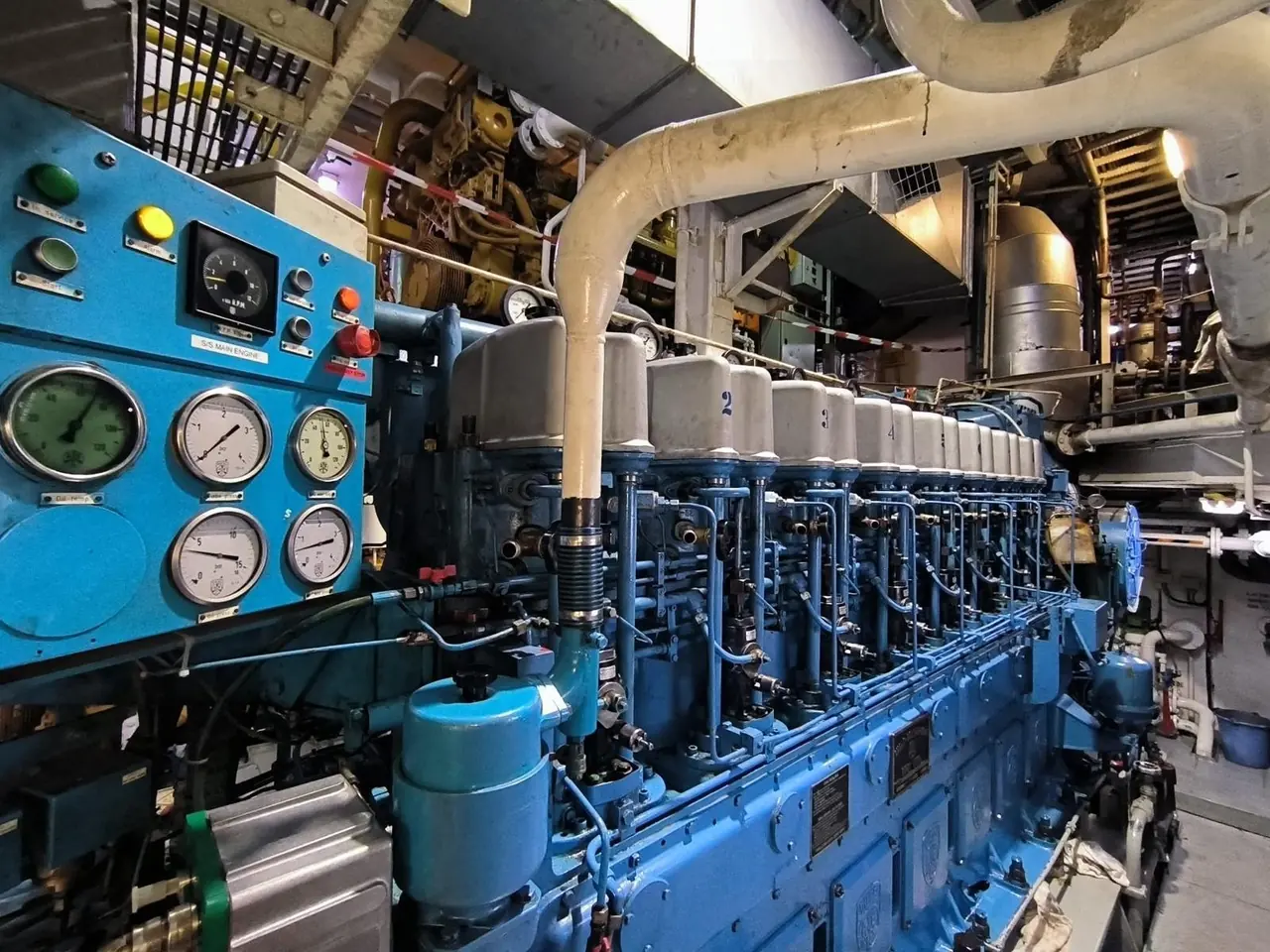
Equipment: Testo 350 MARITIME
The Testo 350 MARITIME is a portable emission analyser for marine diesel engines, approved under MARPOL Annex VI and the NOx Technical Code 2008. It holds DNV and ClassNK type approval and a Marine Equipment Directive (MED) certificate. It is easy to take into the engine room, measures while the engine runs, and records the results.
It can be used for on-board verification surveys under the NOx Technical Code and for the simplified measurement method after engine modifications. Fuel sulphur content can also be calculated from the SO2/CO2 ratio.
What IMO Tier III and EPA Tier 4 mean
IMO Tier III is the strictest NOx limit in MARPOL Annex VI Regulation 13. It applies to diesel engines above 130 kW, and the limit depends on engine speed: 3.4 g/kWh below 130 rpm and 2.0 g/kWh at 2,000 rpm and above. That is roughly 80 per cent lower than Tier I.
Tier III applies only in NOx Emission Control Areas (ECAs): the North American and US Caribbean ECAs for ships built from 1 January 2016, and the Baltic and North Sea ECAs for ships built from 1 January 2021. Outside these areas Tier II applies. The Mediterranean has been a sulphur (SOx) ECA since 1 May 2025, with a fuel sulphur limit of 0.10 per cent.
EPA Tier 4 is the US limit for commercial marine diesel engines. It applies to Category 1 and 2 engines of 600 kW and above and was phased in between 2014 and 2017. For example, engines of 600–1,400 kW have a NOx limit of 1.8 g/kWh and a particulate limit of 0.04 g/kWh.
Engines that meet these limits usually have an SCR (selective catalytic reduction) system. Measurement shows whether the engine and its SCR system are actually running within the limit.
What we measure against which rule
- IMO Tier II and Tier III: NOx compared with the speed-dependent limit
- EPA Tier 4: NOx checks on vessels trading to US waters
- Engines with SCR: NOx before and after the catalyst
- SOx ECAs (including the Mediterranean): fuel sulphur and scrubber checks from the SO2/CO2 ratio
What we measure
- Nitrogen oxides (NOx: NO and NO2)
- Carbon monoxide (CO)
- Carbon dioxide (CO2)
- Oxygen (O2)
- Sulphur dioxide (SO2)
- Exhaust gas temperature
When it is needed
- Checking combustion settings after an overhaul or maintenance
- Higher fuel consumption, black smoke or high exhaust temperatures
- Suspected imbalance between cylinders
- Preparing for MARPOL Annex VI surveys and port state control
- Checking the SCR system before entering an ECA
- Commissioning and acceptance tests of a new engine
What you receive
We measure at different engine loads and report the values together with the engine’s operating data. If values are outside the normal range, the report gives the likely causes and the maintenance required.
How a measurement job runs
- You send us the engine model, serial number and the reason for the measurement.
- Together we plan the measuring points and the load steps the engine can run at.
- We carry out the measurement on board or on site.
- We report the results and, if needed, send a maintenance quote.